

Jotun Application Manual
China-based distributor of Jotun industrial protective coatings — supplied from the China production base to projects worldwide.
Standard service process for repair customers
The manual sets out the full service process from first enquiry to project close, with the Jotun service provided at each step:
| Steps | Jotun service |
|---|---|
| Discussing repair needs | A general repair manual is provided to customers, with discussion of their repair needs. |
| Survey and assessment | Carry out corrosion inspection on each part of the equipment as the customer requires; this can be done through the Jotun Asset Management Programme (JAMP), or by introducing a national corrosion assessment body. |
| Proposing a repair scheme or plan | Based on the assessment of each area, a repair scheme and plan are agreed with the customer. |
| Carrying out the repair | Repair should be carried out by a Jotun-approved applicator, or Jotun can provide on-site technical service to the applicator the customer chooses. |
| Inspection and acceptance | Jotun's on-site technical service carries out inspection together with the owner and provides daily application reports and a completion report, or recommends a third-party inspection body. |
| Project close | A customised repair manual is provided to customers. |
How to use this manual
This manual is a general repair scheme for anticorrosive coatings. In day-to-day maintenance it allows the right repair products to be identified quickly, so a workable scheme can be given for the specific situation and repair efficiency improves.
When using this manual the application procedures it sets out must be followed strictly, so that repair work is carried out correctly. If any operation conflicts with the application procedure, or a situation arises that this manual does not cover, contact our technical service to agree a suitable solution.
Because products are updated from time to time and repair schemes are continually improved, the content in this manual is for reference only; for specific product information, repair schemes and application procedures, consult our technical service. Copyright and interpretation of the manual belong to Jotun.
Repair scheme overview
Repair schemes are organised as component → operating temperature → applicable condition. Each scheme carries a scheme number (S) and an application procedure number (T), together with the recommended products. P1 to P5 are the five repair areas:
| Area | Number | Operating temperature | Applicable conditions | Recommended products |
|---|---|---|---|---|
| Steel structures / pipelines / pumps / valves / tanks / reactors and other equipment / walkways and platforms | P1 | Ambient (-40 °C to 120 °C) | Major repair (original system known and two-component): scheme S1-1 / procedure T1-1 | Jotamastic 90 |
| Unknown existing coating: scheme S1-2 / procedure T1-2 | Pilot ACR | |||
| Small-area repair: scheme S1-3 / procedure T1-3 | Jotamastic Smart Pack | |||
| Pipelines, steel structures (medium temperature) | P2 | Medium temperature (120–200 °C) | Shutdown (insulated or uninsulated): scheme S2-1 / procedure T2-1 | Epoxy HR |
| On line (insulated or uninsulated): scheme S2-2 / procedure T2-2 | Epoxy HR | |||
| Pipelines, steel structures (high temperature) | P3 | High temperature (200–650 °C) | Shutdown (insulated or uninsulated): scheme S3-1 / procedure T3-1 | Jotatemp 650 |
| On line (insulated or uninsulated): scheme S3-2 / procedure T3-2 | Jotatemp 650 | |||
| Damp surfaces (splash zone) | P4 | Ambient (-40 °C to 120 °C) | Damp surface: scheme S4 / procedure T4 | Marathon 500 |
| Tank interior | P5 | By stored medium | Light hydrocarbons, alkali: scheme S5-1 / procedure T5-1 | Tankguard Plus |
| Heavy hydrocarbons: scheme S5-2 / procedure T5-2 | Tankguard NCV | |||
| Alcohols: scheme S5-3 / procedure T5-3 | Tankguard Zinc | |||
| Concentrated sulphuric acid: scheme S5-4 / procedure T5-4 | Chemflake Special |
Application procedure numbers for the schemes: T1-1 Jotamastic 90 ambient-temperature repair (-5 to 40 °C); T1-2 Pilot ACR fast-drying acrylic primer/topcoat ambient-temperature repair (-15 to 40 °C); T1-3 Jotamastic Smart Pack ambient-temperature spot repair (-5 to 40 °C); T2-1 Epoxy HR phenolic epoxy heat-resistant coating, shutdown repair (10 to 40 °C); T2-2 Epoxy HR, on-line repair (40 to 150 °C); T3-1 Jotatemp 650 high-build inert copolymer high-temperature coating, shutdown repair (10 to 40 °C); T3-2 Jotatemp 650, on-line repair (150 to 400 °C); T4 damp-surface ultra-high abrasion-resistant epoxy repair (-5 to 40 °C).
Content taken from the Jotun Application Manual (July 2014), checked after OCR.
Products recommended in the manual
P1 ambient areas (-40 °C to 120 °C)
Jotamastic 90 modified epoxy abrasion-resistant coating
Keyword: surface-tolerant;-5 °C low-temperature application. Excellent corrosion protection. Good brush and roller application.
Modified epoxy abrasion-resistant 90 is a two-component surface-tolerant abrasion-resistant high-solids modified epoxy primer/topcoat that can be applied over a wide film thickness range. Volume solids up to 80%, building up to 300 µm in one coat, which reduces the number of coats and the amount of application work.
This surface-tolerant coating accepts surfaces prepared to St2 by hand or power tools as well as water-jetted surfaces, and protects areas where abrasive blasting is impractical on site; it can be applied at temperatures down to -5 °C, applies well by brush and roller, and offers a wider colour range than most other epoxies.
Pilot ACR fast-drying acrylic primer/topcoat
Keyword: one-component. Fast drying. Primer and topcoat in one. Can be tinted.
One-component high-solids fast-drying acrylic primer/topcoat. It can be used as a single coat in C2 atmospheric corrosivity, or as a topcoat over various primers, and is particularly suited to day-to-day topcoat repair. Volume solids 55%, excellent brush and roller application and very good compatibility with substrates and existing coatings: it can be applied to surfaces prepared to St2 by power tools or WJ2 by ultra-high-pressure water jetting, and over sound, clean epoxy, alkyd and acrylic coatings.
The product can be applied at -15 °C, reaching surface dry in 30 minutes and hard dry in 7 hours at -10 °C, which helps with time management on day-to-day repair work; it is tintable, and no colour uses lead or chrome pigments.
Jotamastic Smart Pack 1+1
Keywords: 1:1 mixing ratio; outstanding brush and roller performance; 5 L packs.
Two-component surface-tolerant high-solids modified abrasion-resistant epoxy maintenance coating, mixed 1:1 base to hardener for easy on-site preparation and lower paint loss, designed for brush and roller application.Volume solids 72%; brushing or rolling readily achieves 50–120 µm dry film thickness; Also a surface-tolerant coating: it accepts surfaces prepared to St2 by hand or power tools and water-jetted surfaces.
P2 medium temperature (120–200 °C)
Epoxy HR phenolic epoxy heat-resistant coating
Keyword: 200 °C service. Thermal cycling. Condensation. Corrosion under insulation.
A two-component high-solids heat-resistant phenolic epoxy coating, particularly suited to corrosion protection of pipeline exteriors and other steel surfaces at temperatures up to 200 °C, both uninsulated and in insulated, thermally cycling conditions with condensation. Solids content up to 63%, building 200 µm in one coat, and can be applied directly to operating equipment surfaces at up to 150 °C without shutdown.
P3 high temperature (200–650 °C)
Jotatemp 650 high-build inert copolymer high-temperature coating
Keyword: continuous 650 °C service. Thermal cycling between -185 °C and 540 °C. Surface-tolerant. Application to surfaces at 400 °C. Condensation. Corrosion under insulation.
High-build, one-component inert copolymer coating designed to protect substrates in extremely hot and/or extremely cold service. It withstands continuous service at 650 °C in dry conditions and short peaks to 720 °C, and is particularly suited to severe corrosion protection of insulated carbon and stainless steel and to thermal cycling between -185 °C and 540 °C.
- It suits continuous service at 650 °C with peaks to 720 °C, and intermittent immersion in boiling water at 100 °C.
- Long-term adhesion on insulated and uninsulated carbon and stainless steel.
- Excellent surface tolerance; accepts mechanical or hand preparation to St2.
- UV resistant; air-drying; can be applied directly to operating equipment surfaces up to 400 °C.
- No specialist coating equipment or special preparation needed.
P4 damp surfaces / splash zone (-40 °C to 120 °C)
Marathon 500 ultra-high abrasion-resistant epoxy
Keyword: surface-tolerant. Application to damp surfaces. Cures under water.
Two-component surface-tolerant high-solids abrasion-resistant epoxy primer that continues to cure under water and can be applied at high film thickness. Volume solids up to 85%, building up to 500 µm in one coat.Excellent corrosion protection on many metal substrates such as carbon steel and galvanised structures;Suitable for atmospheric, underwater immersion and soil immersion service, alone or with a topcoat, particularly in severe environments, the splash zone and areas exposed to tidal movement. Can be applied to damp surfaces and immersed in water before it is fully cured.
- A surface-tolerant coating for surfaces prepared to St2 by hand or power tools.
- Can be applied to damp surfaces and cures at temperatures as low as 0 °C.
- Sixty minutes after application (at 23 °C) it can be immersed in seawater and continue to cure.
P5 tank interior (selected by stored medium)
Tankguard Plus phenolic epoxy coating for high-temperature tanks
Keywords: sour crude at 160 °C; refined products; caustic soda solution; a wide range of chemicals.
Two-component high-solids phenolic epoxy resistant to crude oil up to 160 °C.It resists a very wide range of chemicals and solvents and withstands higher temperatures than comparable products. Recommended as internal lining for steel storage tanks handling hot crude oil, refined products, caustic soda solution, aromatic solvents and other chemicals.Volume solids up to 70%, building up to 150 µm in one coat; Once fully cured it can contact food and meets the FDA standard in US CFR Title 21, Section 175.300.
The manual's table of tank lining media against temperature
- Crude oil, catalytic slurry at 25 °C. Fire water, jet fuel, heavy reformate C5, LPG, propane, 93 octane gasoline, alkali solution at 20 °C. Isopentane, hydrocracker light naphtha at 2.2 °C / 26.9 °C;C4, heavy C4 37℃;FCC LPG, reformer debutaniser bottoms at 36 °C. Emergency slop slurry, vacuum residue, crude/vacuum light gas oil at 150 °C. Fuel oil, heavy slop oil at 90 °C.
- Hydrocracker tail oil at 75–90 °C. Straight-run diesel, cracked diesel, hydrotreated residue diesel at 50 °C. Benzene, P-X, cracked gasoline (C6-C8), naphtha at 40 °C;O-X, heavy aromatics, mixed naphtha, hexane, MTBE, aromatics raffinate, reformate, cracked gasoline, light slop oil, diesel at 20 °C.
- Waste ethylene glycol and triethylene glycol at 50 °C; methanol, ethylene glycol, octanol, liquid mixed alcohol (
- Concentrated sulphuric acid at 20 °C (with Chemflake Special).
Tankguard NCV phenolic epoxy static-conductive coating
Keyword: static-conductive. Various chemicals.
Two-component high-solids phenolic epoxy resistant to a wide range of chemicals and solvents. Solids content up to 63%, building 150 µm in one coat, for static-conductive internal lining of steel storage tanks; resistant to crude oil, clean petroleum products and a range of solvents (benzene, toluene, xylene, butanol, ethylene glycol, nitrobenzene, formaldehyde and others). Meets the static-conductive requirements of the mandatory national standard GB 50393-2008 (Technical code for anticorrosion engineering of steel petroleum storage tanks) and is widely used for internal lining of crude and refined product tank farms in China and abroad.
Tankguard Zinc inorganic zinc silicate zinc-rich cargo tank coating
Keywords: moisture-curing; alcohol-resistant.
Two-component moisture-curing ethyl silicate zinc-rich coating with 86% zinc dust, meeting SSPC Paint 20 Level 1 and the zinc content requirements of ISO 12944. The zinc dust meets ASTM D520 Type II with a maximum lead content of only 100 ppm (ordinary zinc dust can reach 2,000 ppm). Solids up to 67%, building 170 µm in one coat. Used mainly for chemical cargo tanks and tank linings, particularly with aggressive chemicals such as methanol, ethanol, styrene, propanol and acetone.
Chemflake Special vinyl ester glass-flake coating
Keyword: strong acid resistance, high-temperature aggressive media.
Fast-curing, highly abrasion-resistant, glass-flake reinforced unsaturated vinyl ester high-build coating designed specifically for internal lining of tanks holding strongly corrosive chemical media such as strong acids, particularly at high temperature. Peroxide catalysts together with accelerators and inhibitors let the unsaturated vinyl ester cure fully in a very short time. The target environments are high-temperature, highly corrosive duties; actual applications include flue gas desulphurisation (FGD) units, hot acid chimneys, acid storage tanks and acid handling tanks in chemical plants.
- Solids up to 96%, building up to 1,000 µm in one coat.
- VOC content is only 36 g/l (UK-PG6/23(97) Appendix 3), close to solvent-free.
- It can be fully cured and put into service within one day.
- It resists strong acids such as sulphuric and hydrochloric acid (the manual gives resistance temperatures for 10%, 20% and 37% HCl and 10%, 50%, 70% and 98% H2SO4).
- It withstands dry temperatures up to 160 °C and intermittent temperatures up to 180 °C.
- No specialist coating equipment needed.
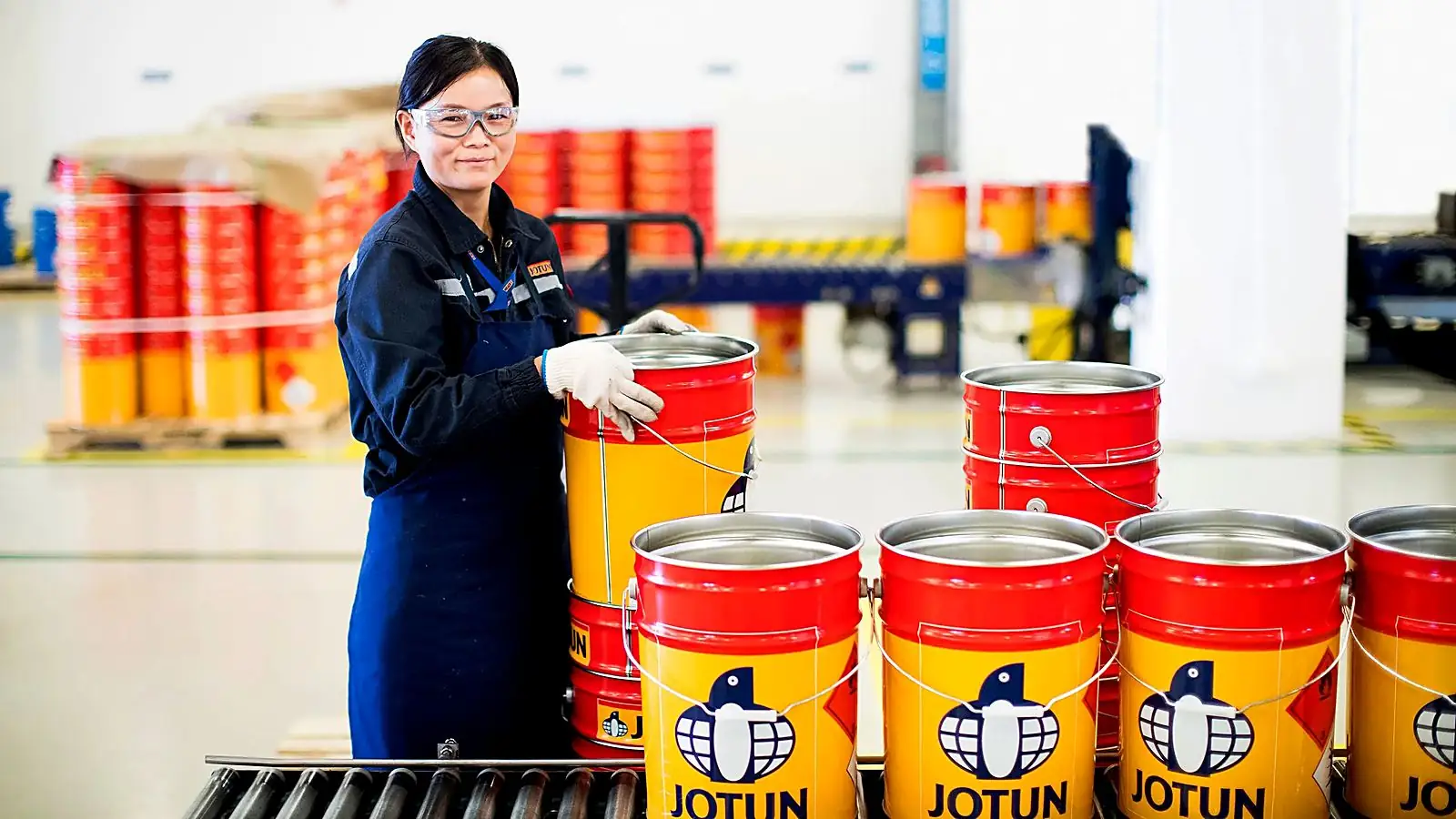
From ambient to 650 °C, products are tiered by service condition
Repair schemes select products by equipment component and operating temperature: the same component at different temperatures takes a different product and procedure.
General colour schedule (manual appendix)
The manual gives the surface and marking colours of common petrochemical equipment and piping; the actual colours follow the Jotun colour card.
| Equipment category | Equipment type | Surface colour | Marking colour |
|---|---|---|---|
| Static equipment | General vessels, columns / heavy product tanks | Silver AL RAL 9006 | Bright red RAL 3000:STD 823 |
| Reactors, heat exchangers | Silver AL RAL 9006 | Bright red RAL 3000:STD 823 | |
| Tanks / other equipment | Silver AL RAL 9006 | Bright red RAL 3000:STD 928 | |
| Industrial furnaces / boilers | Silver AL RAL 9006 | Bright red RAL 3000:STD 928 | |
| Pumps | Pumps | Silver AL RAL 9006 | Bright red RAL 3000:STD 823 |
| Mechanical equipment | Motor | Light stone grey RAL 7046 | Bright red RAL 3000:STD 823 |
| Compressors, centrifuges / fans | Silver AL RAL 9006 / sky phthalo blue RAL 5012 | Bright red RAL 3000:STD 823 | |
| Steel chimney / flare stack | Silver AL RAL 9006 | Bright red RAL 3000:STD 928 | |
| Electrical and instrument equipment | Switchgear and panels / transformers / distribution boxes | Sea grey RAL 7035 / STD 967 | Bright red RAL 2000:STD 928 |
| Consoles / instrument panels / field instrument boxes / panel-mounted instruments | Sea grey RAL 7035 / STD 967 | Bright red RAL 3000:STD 823 | |
| Cable trays and troughs | Sea grey RAL 7035 / STD 967 | — | |
| Process piping | General products / steam / air and oxygen / nitrogen | Silver AL RAL 9006 / sky phthalo blue RAL 5012 / pale yellow RAL 1021 | Bright red RAL 3000:STD 928 |
| Acids and alkalis | Pipe purple RAL 4005 | Bright red RAL 3000:STD 928 | |
| Water / wastewater | — / black STD 099 | White STD 001 | |
| Ammonia / emergency blowdown lines | Mid yellow RAL 1003 / STD 1800 | Bright red RAL 3000:STD 928 | |
| Fire protection piping / instrument conduit / instrument air lines | — | Bright red RAL 3000:STD 928 / black STD 099 | White STD 001 |
| Valve | Valve bodies (carbon steel / alloy steel), handwheels and handles | Mid grey RAL 7037 / mid phthalo blue RAL 5005 | — |
| Frames, platforms, ladders | Beams, columns, bracing and hangers / handrails (with posts), guard rails and handrails / kick plates | Mid grey RAL 7037 | — |
Colours shown are for reference only; refer to the Jotun colour card.
Content taken from the Jotun Application Manual (July 2014), checked after OCR.
On-line repair procedure (example)
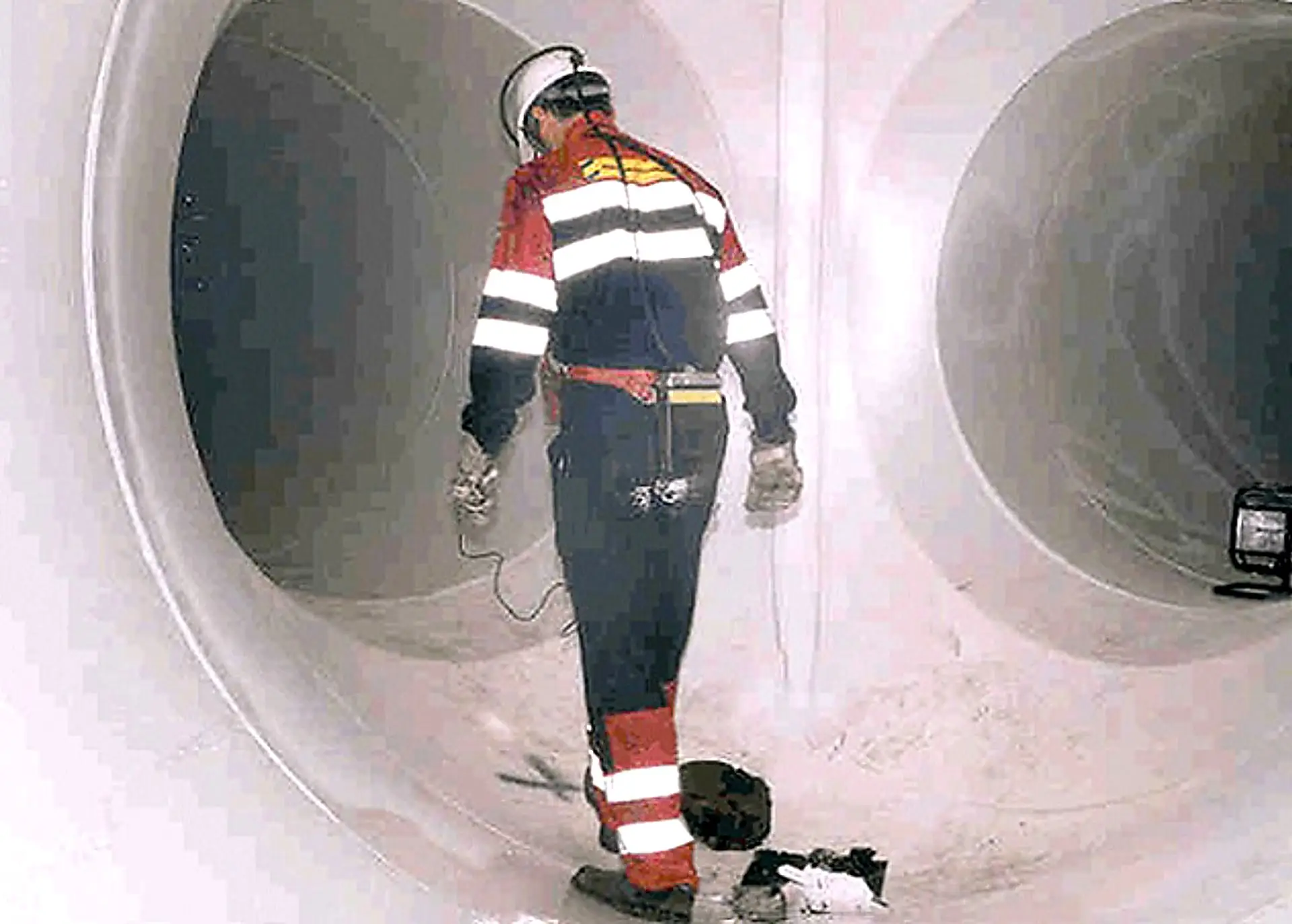
On-line repair: surface preparation and coating at operating temperature
For on-line schemes on medium and high temperature areas the key is the choice of surface preparation grade and control of the intervals between thin coats.
Scheme S2-2: on-line repair at surface temperatures of 40–150 °C
| Project | Contents |
|---|---|
| Scheme description | This scheme applies to pipelines and steel structures repaired on line at surface temperatures of 40 °C to 150 °C. |
| Application temperature | 40℃~150℃ |
| Operating temperature | 120℃~650℃ |
| Substrate | Carbon steel, low-alloy steel |
| Corrosive environment | Water, oxygen, high temperature |
| Surface preparation | Thorough hand and power tool cleaning to St2 (ISO 8501-1:2007). Viewed without magnification, the surface should be free from visible oil, grease and dirt, and free from poorly adhering mill scale, rust, paint and foreign matter; any remaining contamination should be firmly attached. Also make sure no mill scale remains. |
| Repair system | 1st inorganic zinc-rich primer 50 µm; 2nd silicone heat-resistant coating 25 µm; 3rd silicone heat-resistant coating 25 µm; total film thickness 75–100 µm (at 23 °C) |
| Coating parameters (Epoxy HR) | 1st Epoxy HR 125 µm; 2nd Epoxy HR 125 µm; total film thickness 250 µm. Thinner No. 23, mixing ratio 6.5:1, pot life after mixing 4 hours (at 23 °C). |
| Recoat interval (Epoxy HR) | 10 °C: minimum 26 h / maximum 21 d; 15 °C: minimum 20 h / maximum 14 d; 23 °C: minimum 10 h / maximum 7 d. |
| Applicable areas | High-temperature piping, valves, supporting steel structures and similar. |
| Surface preparation tools | Corner grinder, power wire brush, grinding heads, abrasive discs, wire wheels, hand wire brush, scraper, pointed hammer. |
| Application equipment | Hot surfaces are hard to reach, so airless spray should be used. |
| Safety note | Operators working on hot surfaces must wear heat-resistant gloves and other protective equipment to prevent burns. |
Procedure T2-2: Epoxy HR phenolic epoxy heat-resistant coating, on-line repair
Step 1: fire separation
To ensure safe production and application, necessary fire separation measures must be in place before protective coating work; the measures are set with each owner's fire requirements and the site conditions.
Step 2: remove grease
Surfaces to be coated with Epoxy HR must be degreased, water jetted and power-tool prepared before application. Flushing fresh water must have a conductivity below 250 μS/cm. Wear heat-resistant gloves for safety.
Grind the whole flange surface first with a rotating wire brush to remove the chalking layer, firmly attached debris and other contamination; then grind corroded and damaged areas to St2 (ISO 8501-1:2007 or GB/T 18839:2002) or better with a sanding disc, feathering the edge where it meets sound coating.
Step 3: mixing
Epoxy HR phenolic epoxy heat-resistant coating is a two-component product mixed at A:B = 6.5:1 by volume. Stir the base (A) with a power mixer first, then combine the whole of the hardener (B) with the base (A) and mix thoroughly with a power mixer.
Stir the base and the hardener separately, then pour the hardener slowly into the base while stirring continuously. Add no more than 5% of Thinner No. 23 to the hardener, stir, pour everything into the base, stir until uniform and leave to induct for 20 minutes.
Epoxy HR normally needs no thinning; where viscosity has to be adjusted on site, up to 5% Jotun Thinner No. 23 may be added and no more than 10% is advised, to avoid sagging or other defects — the amount depends on temperature. Pot life after mixing is 4 hours at 23 °C and shortens as temperature rises; paint past its usable life will fail and must not be revived with thinner.
Applying Epoxy HR to a hot substrate readily produces dry spray; this is normal.
Step 4: apply the coating
Prepared structures must be coated before rust re-forms on the surface. Sequence: mix → stripe coat the primer → full primer coat → spray the topcoat.
First brush-apply primer over damaged areas; after stripe coating, spray the first coat of Epoxy HR to the required film thickness. Where Epoxy HR is applied to surfaces held continuously at 100–150 °C, build the film in several thin coats rather than in one pass: with typical films, allow at least one hour between coats so each coat dries through, continuing until the specified system thickness is reached.
Overlap each pass by 50% when spraying, avoid arcing strokes, and avoid spraying from too far away or dry spraying; use a wet film comb to keep the film uniform.
Airless spray parameters
- Nozzle pressure: 15 MPa (150 kp/cm², 2,100 psi)
- Nozzle size: 0.46–0.69 mm (0.018–0.027″)
- Nozzle angle: 40–80°
- Check and keep the filter clean
Application conditions
- Substrate temperature during application should normally be at least 10 °C and at least 3 °C above the air dew point.
- Relative humidity measured close to the substrate should be below 85%.
Step 5: spray the topcoat
Spray the second coat of Epoxy HR fully. Allow a recoat interval of at least 30 minutes before applying the second coat. Because wet and dry film thickness are hard to measure at high temperature, paint consumption is calculated from area and thickness requirements, with a loss factor of roughly 40–70% to control film thickness through paint volume and loss.
After application, protect the coating from rain until it is surface dry; do not leave it to cure in cold, damp conditions, which can cause poor curing or film formation.
Step 6: final acceptance
On completion the work is accepted jointly by the owner and the supervisor. Film acceptance combines visual inspection with instruments. Dry film thickness is measured with a magnetic gauge in accordance with SSPC PA2:2004 (Measurement of Dry Coating Thickness with Magnetic Gauges). The finished film should be complete and well formed, free from sagging, cracking and orange peel, uniform in colour and of the specified thickness.
Content taken from the Jotun Application Manual (July 2014), checked after OCR.
Appendices 1 and 2: failure assessment and surface preparation grades
Appendix 1: Coating failure assessment (ISO 4628-3)
| Rust grade | Rusted area | Treatment decision |
|---|---|---|
| Ri0 | 0% | — |
| Ri1 | 0.05% | — |
| Ri2 | 0.5% | Local repair required |
| Ri3 | 1% | Major repair required |
| Ri4 | 8% | Major repair |
| Ri5 | 40~50% | Major repair |
Figure taken from standard ISO 4628-3; at Ri2 local repair is due, at Ri3 major repair is due.
The surface preparation grade sets where the repair scheme starts
Hand and power tool cleaning, abrasive blasting and sweep blasting give different cleanliness grades and call for different subsequent coats.
Appendix 2: Surface preparation grades
1. Rust grades of steel surfaces (ISO 8501-1)
- A — mill scale covers most of the steel surface and is firmly adherent, with no rust or very little.
- B — rusting has started on the steel surface and mill scale is beginning to flake.
- C — mill scale on the steel surface has rusted or can be scraped off easily, but only a few pits are visible at normal viewing.
- D — mill scale on the steel surface has rusted away and general pitting is visible at normal viewing.
2. Hand and power tool preparation
Tools: pointed hammer, scraper, wire brush, abrasive paper; rotary surface scaler, needle gun, grinding discs, abrasive discs, wire wheel.
| Cleanliness grade | Requirements |
|---|---|
| St2 thorough hand and power tool cleaning | Viewed without magnification, the surface should be free from visible oil, grease and dirt and almost free from poorly adhering mill scale, rust, coating and foreign matter.(If mill scale, rust or coating can be scraped off with a filling knife, it counts as poorly adhering.) |
| St3 very thorough hand and power tool cleaning | As St2, but much more thorough: the surface should show the sheen of the metal. |
3. Abrasive blast cleaning grades
| Grade | Requirements |
|---|---|
| Sa1 light blast | Viewed without magnification, the surface should be free from visible oil, grease and dirt and free from poorly adhering mill scale, rust, coating and foreign matter. Any residue should be firmly attached. |
| Sa2 thorough blast cleaning | Viewed without magnification, the surface should be free from visible oil, grease and dirt and almost free from mill scale, rust, coating and foreign matter. Any residue should be firmly attached. |
| Sa2½ very thorough blast cleaning | Viewed without magnification, the surface should be free from visible oil, grease and dirt and free from mill scale, rust, coating and foreign matter. Any residual staining should be only slight, spotty or streaky discolouration. |
| Sa3 blast to bare steel | Viewed without magnification, the surface should be free from visible oil, grease and dirt and free from mill scale, rust, coating and foreign matter. The surface should have a uniform metallic appearance. |
4. Galvanised surfaces
Clean grease and oil to SSPC-SP1 with a suitable detergent, then high-pressure water wash the whole surface at not less than 350 bar to remove salts and other contamination. Once the surface is dry, key the whole area with 80–120 grit abrasive paper. Where sweep blasting is available, cleaning and drying the surface and sweep blasting the whole area with non-metallic abrasive to SSPC-SP7 gives better surface profile and adhesion for subsequent coats.
5. Stainless steel surfaces
Clean grease and oil to SSPC-SP1 with a suitable detergent, then high-pressure water wash the whole surface at not less than 350 bar to remove salts and other contamination.Once the surface is dry, sweep blast the whole area with non-metallic abrasive to SSPC-SP7; Where sweep blasting is not possible, the whole surface can be keyed with 80–120 grit abrasive paper.
6. Concrete surfaces
Clean surface laitance, weathered layer and other contamination by abrasive blasting, high-pressure fresh water jetting or power tool grinding to obtain a suitable surface profile. Under GB 50212-2002 the maximum permitted moisture content of concrete before coating is 6%.Before coating, the surface should be clean and dry, free from salts, oil, dust, old coating and loose or laitic concrete;Visible cracks should be filled and levelled with a suitable filler. For the first coat, a proprietary sealer is recommended to seal the prepared concrete surface effectively.
Content taken from the Jotun Application Manual (July 2014), checked after OCR.
Appendices 3 and 4: application methods and coating defect treatment
Appendix 3: Coating application methods
Brush application
An old method using a wool or bristle brush: it saves paint, is simple to apply with basic tools, easy to learn and flexible in use.
- Advantages: good penetration and wetting drive the coating into the steel surface; the rubbing action of the brush helps adhesion; suited to maintenance work, where the first coat applies far better than by roller; for areas that cannot be sprayed properly, brushing shows its advantage.
- Disadvantages: low build per pass, so several passes are needed to reach the specified thickness; the film is less even and the finish inferior to spraying; application is slower and output lower.
Roller application
A method in which paint is picked up on a roller and rolled onto the work.
- Advantages: on large flat surfaces roller application beats brushing and is far faster and more productive; it is simple to operate and semi-skilled workers also achieve satisfactory results.
- Disadvantages: poorer surface penetration and wetting, so not recommended for the first coat; air is easily trapped in the film, causing blisters; low build per pass, so several coats are needed; cannot handle high-viscosity, high-build anticorrosive coatings.
Conventional air spray
The paint is atomised by compressed air and carried to the component in the air stream. Air and paint enter the gun through separate passages, mix, and leave the nozzle in a defined spray pattern.
- Advantages: the fan pattern adjusts easily to any required width; safer than airless spraying by comparison; good film quality — uniform thickness, smooth and level, giving the best decorative result.
- Disadvantages: heavy overspray and high paint loss, i.e. low transfer efficiency; high thinner consumption with heavy solvent evaporation, which pollutes the air and creates a harsh working environment with fire and explosion risk — good ventilation is essential; paint often has to be over-thinned, giving a low dry film thickness per coat; low output, and the operator must refill frequently.
Airless spray
The paint is not atomised by compressed air: pressurised paint released through the nozzle expands abruptly, breaking into fine droplets that are deposited on the structure.
- Advantages: no compressed air is needed to atomise the paint, so airborne contamination cannot foul the film; no pressure pot needed; equipment can be air, electric or hydraulic powered; much faster output, and most coatings build a thicker film in one pass; suited to spraying large, regular component surfaces; particularly suited to modern high-solids coatings.
- Disadvantages: the fan width of each nozzle is fixed and cannot be changed; difficult to coat small complex items because of the fluid flow rate; where only a small area is sprayed at a time (a few square metres), paint loss is higher.
Air-mix spraying
Air-mix spraying combines the advantages of air spray and airless spray. Atomisation comes from two sources: from the liquid, as pressurised paint expands abruptly on release, and from the gas, as compressed air flow further breaks up the paint — twin atomisation.
- Advantages: very high transfer efficiency, up to 80%, saving paint compared with air spray; less overspray, which reduces spray booth maintenance and lowers operator exposure and environmental impact; almost no overspray, with excellent finish and surface quality; faster output, with thicker films per pass than air spray; very low air and energy consumption.
- Disadvantages: not suitable for coatings containing metallic particles; relatively high demands on compressed air quality; lower build per pass than airless spraying.
Appearance and protection are two sides of one system
Most common coating defects come from surface preparation, mixing ratio or application conditions rather than from the paint itself.
Appendix 4: Common coating defects and treatment
The manual takes each defect in turn — cause, repair, prevention. The 14 common defects follow:
1. Sagging
- Causes: spray gun too close to the steel, wet film too thick; too much solvent added or the wrong hardener; substrate too smooth or poor application technique; substrate surface temperature too high or too low, or ambient (paint) temperature too low.
- Repair: lay off with a brush before the coating dries/cures; if already dried/cured, sand or remove it, or blast; then apply a new coat.
- Prevention: keep the gun 30–60 cm away and at 90°; stripe coat corners and areas that are hard to spray first; set the pressure to suit the pump ratio, hose length, film thickness and component size; add thinner according to nozzle size, weather conditions, solids content and viscosity; work within an ambient temperature of 5–45 °C where possible.
2. Missed areas
- Causes: spray gun too far from the steel, paint viscosity too high; ambient (paint) or substrate temperature too high; wind speed too high while spraying; low thinner addition with rapid evaporation; incorrect spraying technique.
- Repair: sand once the coating has dried/cured; apply a fresh coat; if the topcoat is a high-build product, thin it slightly before spraying to improve flow.
- Prevention: keep the gun 30–60 cm away and at 90°; stripe coat corners and areas that are hard to spray; set the correct pressure; add thinner according to nozzle size, weather, solids and viscosity; keep ambient temperature at 5–45 °C and the paint below 35 °C.
3. Orange peel / wrinkling
- Causes: paint viscosity too high; single coat sprayed too thick; spray gun too close to the steel; component temperature too high, or strong heat and sun after coating; spray equipment pressure too high.
- Repair: lay off with a brush before the coating dries/cures; if already dried/cured, sand or remove it, or blast; adjust the spray parameters; apply a new coat.
- Prevention: set the correct pressure; add thinner according to nozzle size, weather, solids and viscosity; the surface to be coated needs a good profile; keep ambient temperature at 5–45 °C and the paint below 35 °C.
4. Wrinkling / lifting
- Cause: a new coat applied before the previous one has dried, or a film that surfaces dry quickly while solvent escapes slowly from within. It is usually caused by solvents in the new coat being too aggressive for the previous coat, or by an unsuitable system; such wrinkling can lead to coating detachment.
- Repair: first case — sand or remove, then repair; second case — recoat.
- Prevention: follow the drying and overcoating times in the product TDS strictly; coating systems must be reviewed by technical staff and not changed at will; use the companion thinner only — never substitute.
5. Dry spray
- Causes: spray gun too far from the steel; ambient (paint) or substrate temperature too high; low thinner addition with rapid evaporation; incorrect spraying technique.
- Repair: before the coating dries/cures, brush off overspray and wipe with solvent; if already dried, remove with a glass slide, scraper or abrasive paper; then clean with abrasive paper and apply the new coating.
- Prevention: keep the gun 30–60 cm away and at 90°; ambient temperature 5–45 °C, paint below 35 °C and wind below 2 m/s; set the correct pressure; add thinner according to nozzle size, weather, solids and viscosity; provide proper spray support arrangements (ladders, scaffolding and similar).
6. Pinholing
- Causes: a coat sprayed too thick, or water or oil present; ambient (paint) or substrate temperature too high, so solvent evaporates too fast; spraying from too far away; incorrect solvent used; excessive ventilation or strong wind; porous surfaces such as sprayed zinc, sprayed aluminium and inorganic zinc primers are very prone to pinholes.
- Repair: if the coating is not yet dry/cured, touch in with thinned paint using a brush; if it has dried, sand back until no pinholes are visible and touch in; pinholes must not simply be covered by the next coat, because they cannot be covered.
- Prevention: keep the gun 30–60 cm away and at 90°; ambient temperature 5–45 °C, paint below 35 °C and wind below 2 m/s; set the correct pressure; add thinner according to nozzle size, weather, solids and viscosity; ensure the correct thinner is used; provide proper spray support arrangements; seal inorganic zinc and sprayed zinc or aluminium surfaces with a mist coat of sealer first.
7. Bubbles
- Causes: solvent evaporation and film drying are mismatched; air trapped in the paint (particularly a damaged suction pipe drawing in air); ambient (paint) temperature too high; water in the paint, or salts, oil and moisture on the substrate.
- Avoid: soluble salts must be removed from the steel surface before coating (below 10 μg/cm² in atmospheric exposure); the coating must be thick enough to act as a barrier; choose the correct cathodic protection method and match the protection current; avoid contamination of paint or substrate by salt, oil and water; avoid trapping air in the film (roller application).
- Prevention: ensure the correct thinner is used; make sure the surface to be coated is clean, free from water, oil and other contamination; check spray equipment and compressed air lines regularly; ensure the coating dries/cures under normal conditions; ensure ambient conditions meet the requirements — humidity below 85% and steel temperature more than 3 °C above dew point; ensure the correct coating system; mix strictly as the product data sheet requires.
8. Flaking
- Causes: oil, moisture or dust on the substrate or coating surface; condensation on the substrate or coating; amine blush on the previous coat not removed before overcoating; coating interval beyond the product data sheet; incompatible coating system (alkyd topcoat over acrylic topcoat or zinc-rich primer, for example); base and hardener mixed in the wrong ratio, or no hardener added.
- Avoid: make sure the surface is clean, dry and uncontaminated; keep steel temperature at least 3 °C above dew point and humidity below 85% during application; apply correctly as the product data sheet requires; if amine blush is found on the surface, wash with warm water before overcoating, then clean with thinner.
- Prevention: ensure the correct thinner is used; make sure the surface to be coated is clean; check spray equipment and compressed air lines regularly; ensure the coating dries/cures under normal conditions; keep ambient temperature at 5–45 °C, paint below 35 °C and wind below 2 m/s; ensure the correct coating system; mix components A and B strictly as the data sheet states.
9. Chalking
- Cause: ultraviolet light degrades the resin in the coating and the filler loses its binding power. This is particularly severe with epoxy coatings. Chalking is surface degradation of the coating that looks like dust.
- Avoid: high-pressure water cleaning, then remove pigment and filler that has lost adhesion, then recoat; sand the surface and remove all loose material, then apply the new coating.
- Prevention: avoid leaving epoxy in sunlight for long periods; apply the next coat as soon as possible after the epoxy.
10. Cracking / splitting
- Causes: excessive change in the paint's plasticity; coating too thick (particularly inorganic zinc-rich primers); substrate or ambient temperature too high during application or curing; undercoat too soft.
- Repair: sand or remove the cracked surface in small areas; blast larger areas; recoat.
- Prevention: apply the film thickness specified in the product data sheet and application procedure, avoid excessive thickness in a single coat and check with a wet film comb while spraying; for inorganic zinc products in particular, a single coat should not exceed 100 µm dry film thickness; work within an ambient temperature of 5–45 °C where possible.
11. Blushing
- Causes: rain or moisture on a freshly applied coating (water entering the wet film); rain or moisture on the coating before it cures.
- Repair: light cases, wipe with solvent; moderate cases, sand, clean and recoat.
- Prevention: work within an ambient temperature of 5–45 °C where possible; ensure humidity below 85% and steel temperature more than 3 °C above dew point; avoid exposing a freshly applied coating to rain or moisture.
12. Cratering / fish eyes
- Causes: surface contaminated by grease, water, silicone oil and similar; surface contaminated by moisture or foreign matter; cratering can also occur when an incorrect solvent is used.
- Repair: sand and clean the surface thoroughly, or remove the shrunken coating, to obtain a clean surface; recoat as recommended by the coating manufacturer.
- Prevention: ensure the correct thinner is used; make sure the surface to be coated is clean, free from water, oil and other contamination; check spray equipment and compressed air lines regularly; make sure the application tools (rollers, brushes, pails) stay clean, and watch for sweat, moisture and oil contamination.
13. Poor curing
- Causes (two-component coatings): hardener omitted or too little added; hand mixing leaves the paint unevenly mixed; non-compatible hardener added; strong solvent added.
- Repair: for large areas of poor curing, remove the affected coating and recoat; for small areas, the affected coating may be wiped off thoroughly with the companion thinner, and once the surface is dry, carry out normal repair.
- Prevention: mix to the ratio stated in the technical data sheet; mix with a mechanical stirrer.
14. Rust under the coating
- Cause: coating applied to an unprepared or badly prepared surface.
- Treatment: carry out surface preparation again to the specified cleanliness, then coat to the system requirements.
- Prevention: prepare the surface properly as the technical data sheet requires.
Content taken from the Jotun Application Manual (July 2014), checked after OCR.
Appendices 5 and 6: glossary and reference projects
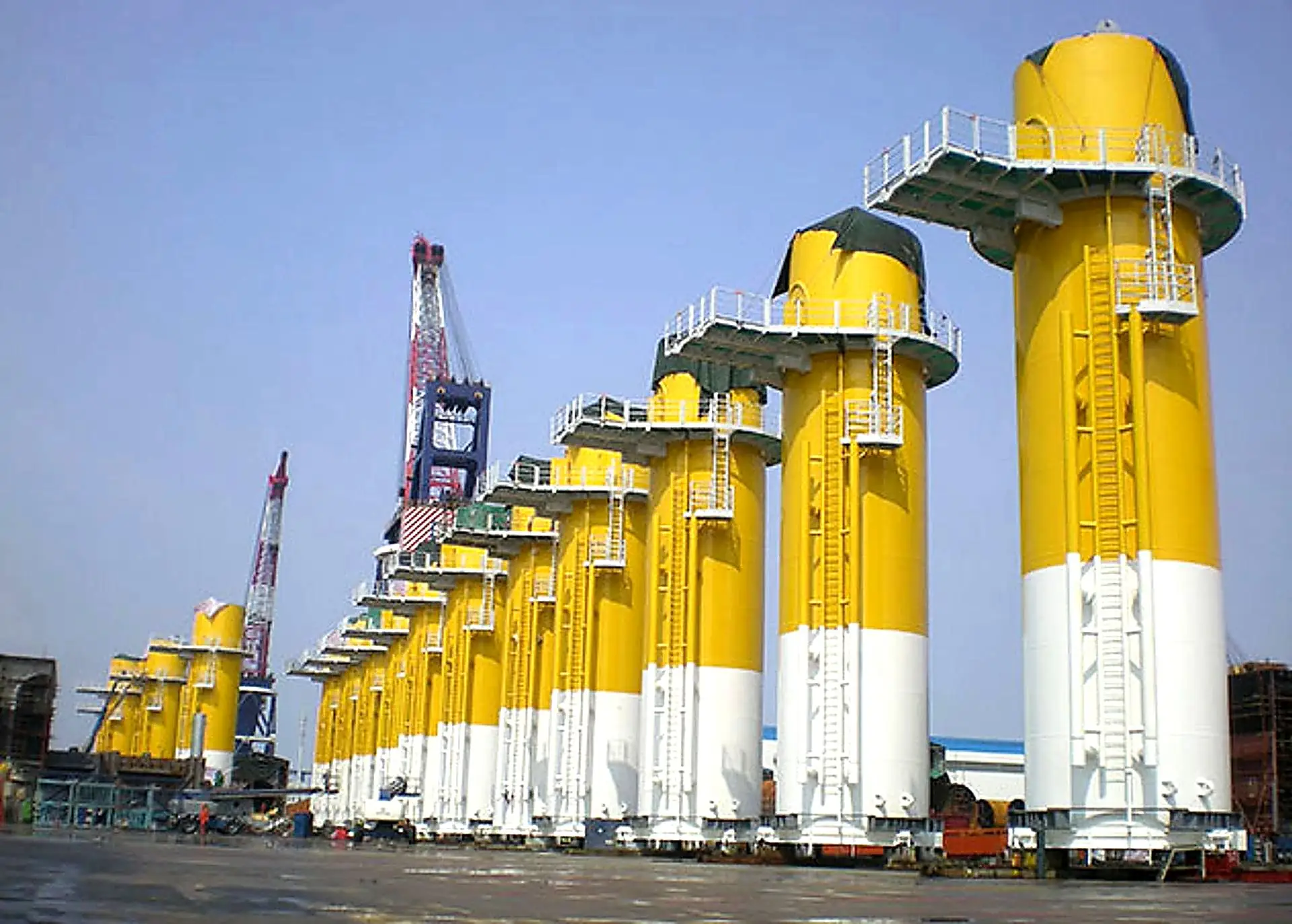
From refinery units to offshore wind: long-term validation of protective coatings
The reliability of a repair scheme comes from long engineering practice: material, surface preparation and application control are all essential.
Appendix 5: Glossary of terms
ISO 12944-2 corrosivity categories
| Corrosivity category | External corrosive environment | Internal corrosive environment |
|---|---|---|
| C1 very low | Inside heated buildings with clean air, such as offices, shops, schools and hotels | — |
| C2 low | Low air pollution, mostly rural areas | Condensation can occur in unheated places such as warehouses and sports halls |
| C3 medium | Urban and industrial atmosphere with moderate sulphur dioxide pollution, low-salinity coastal areas | Production areas with high humidity and some air pollution, such as food factories, laundries, breweries and dairies |
| C4 high | High-salinity industrial and coastal areas | Chemical plants, swimming pools, ships and shipyards |
| C5-1 very high (industrial) | High-salinity industrial areas with aggressive atmosphere | Buildings and locations with constant condensation and high humidity |
| C5-M very high (marine) | High-salinity coastal and offshore areas | Buildings and locations permanently at high humidity and high pollution |
Rusting
Definition: local or general formation of red or yellow iron oxide on the steel surface beneath the film. It is often accompanied by blistering, cracking and flaking of the film. Rated to ISO 4628-3: Ri0 (0%), Ri1 (0.05%), Ri2 (0.5%), Ri3 (1%), Ri4 (8%), Ri5 (40–50%).
Cracking
Definition: a discontinuous change in appearance of the film, usually caused by ageing of the coating.
- ISO 4628-4 crack quantity: 0 none (no visible cracks); 1 cracks visible under 10× magnification; 2 few (small, sparse cracks); 3 few (a number of small cracks); 4 moderate number of cracks; 5 numerous cracks.
- ISO 4628-4 crack size: 0 not visible under 10× magnification; 1 cracks faintly visible under 10× magnification; 2 faint cracks visible to normal sight; 3 clearly visible cracks; 4 cracks larger, up to 1 mm wide; 5 cracks very large, generally wider than 1 mm.
Blistering
Definition: loss of adhesion in a local area lets the coating lift away from the substrate (or from the coat beneath), producing rounded raised areas in the film. The blister may contain liquid, vapour, other gas or crystalline matter.
- ISO 4628-2 blister density: 0 no blisters; 1 very few, a handful of blisters; 2 very few blisters; 3 moderate number of blisters; 4 moderately numerous blisters; 5 dense blisters.
- ISO 4628-2 blister size: S0 no visible blister under 10× magnification; S1 blisters visible under 10× magnification; S2 blisters faintly visible under 10× magnification; S3 blisters visible to normal sight; S4 blisters smaller than 0.5 mm; S5 blisters 0.5–5 mm.
Peeling
Definition: one or more coats detaching from the coat beneath, or the coating detaching completely from the substrate.
| Flaking grade | Flaked area (%) | Size grade | Flaking size |
|---|---|---|---|
| 0 | 0 | 0 | not visible under 10× magnification |
| 1 | 0.1 | 1 | approx. 1 mm |
| 2 | 0.3 | 2 | approx. 3 mm |
| 3 | 3 | 3 | approx. 10 mm |
| 4 | 3 | 4 | approx. 30 mm |
| 5 | 15 | 5 | Over 30 mm |
Chalking
Definition: a loose, powdery layer on the film surface caused by degradation of one or more of the binders and by breakdown of the pigment. The manual assesses chalking by the ISO 4628-6 tape method.
Adhesion
Definition: the firmness with which the film is bound to the surface it coats.
Appendix 6: Industry references
The appendix lists examples of Jotun work in industry, with project name, coated areas, contractor and coating date. Main projects:
| Project name | Coated area | Contractor / owner | Coating date |
|---|---|---|---|
| SINOPEC Guangzhou petrochemical plant repair | Tanks / piping | SINOPEC Guangzhou Petrochemical General Plant | 2003 |
| PetroChina Dalian Petrochemical expansion and repair | Tank interiors and similar | PetroChina Dalian Petrochemical Co. | 2010.08 / 2012.02-2012.12 |
| PetroChina Urumqi Petrochemical tank inspection and repair project | Tank | PetroChina | 2011.09-2012.12 |
| CNOOC and Shell Petrochemicals Co. maintenance | Vertical steel structure | CNOOC and Shell | 2011.12-2012.12 |
| PetroChina Dushanzi maintenance project | Overall | PetroChina | 2012.07-2012.10 |
| Yumen refinery upgrade project | Steel structure | CNPC Seventh Construction Yumen project team | 2013.03-2013.08 |
| PetroChina Sichuan Petrochemical Pengzhou ethylene repair | Repair | CNPC Sixth Construction | 2013.08-2013.10 |
| Formosa Mailiao A3 tank farm anticorrosion maintenance | High-temperature equipment | Formosa Plastics Corporation | 2014.04-2014.10 |
| CNOOC and Shell Nanhai petrochemical project | Tanks / pipelines / equipment steel structures | Shandong Electric Power Construction Co. and Yixing Circulating Water Equipment Co. | 2004 |
| Fujian refining and petrochemical integration project | Steel structures / equipment / pipelines / tanks | SINOPEC Ningbo Engineering Co., SINOPEC Shanghai Engineering Co., SINOPEC Tenth Construction Co. and SINOPEC Second Construction Co. | 2007 |
| Fujian refining and ethylene project | Polypropylene/ethylene units, chemical tank farms, C4 complex, flare unit | SINOPEC Tenth Construction Co., SINOPEC Second Construction Co. and Wison (Shanghai) Chemical Engineering Co. | 2008 |
| PetroChina Xinjiang Dushanzi integrated refinery project | Steel structures / equipment / pipelines / tanks | China Huanqiu Contracting & Engineering Corp., CNPC Sixth Construction Co. and CNPC First Construction Co. | 2007-2008 |
| PetroChina Guangxi Qinzhou 10 million t/y refinery project | Units / steel structures / tanks / pipelines | CNPC First Construction Co., CNPC Seventh Construction Co., North China Petroleum Engineering Construction Co. and Huanqiu Contracting & Engineering Corp. | 2008-2010 |
| CNOOC Refining & Petrochemical Huizhou refinery project | Tanks / pipelines and steel structures | China National Chemical Engineering 14th Construction Co., the 11th Construction Co. and CNOOC Offshore Oil Engineering Co., Huizhou Branch | 2008.03-2008.11 |
| PetroChina Hohhot refinery project | Crude and vacuum units, reformer, benzene extraction, hydrogen purification | PetroChina Hohhot Branch, CNPC Sixth Construction Co. and CNPC Seventh Construction Co. | 2012.04-2012.08 |
| PetroChina Sichuan Petrochemical Pengzhou integrated refining and petrochemical project: 10 million t/y refining and 800,000 t/y ethylene | Steel structures / custom equipment / above-ground piping / tanks | PetroChina Northeast Refining & Petrochemical Engineering Co., Wison (Shanghai) Chemical Engineering Co. and China Chengda Engineering Co. | 2009.07-2013.12 |
| PetroChina Yunnan refining project and Yuntianhua supporting works | Tank | China Huanqiu Contracting & Engineering Corp. | 2013.04-2014.12 |
| PetroChina Guangxi Petrochemical Qinzhou refinery phase II expansion | Steel structure / tanks | Henan Special Anti-corrosion Co., Huanqiu Contracting & Engineering Corp., PetroChina East China Design Institute | 2012.07-2013.06 |
| Gulei PX project | Storage tank | Tenglong Aromatics (Xiamen) Co. and China Construction First Bureau | 2010.10-2011.10 / 2012.07-2013.06 |
| Fujian Gulei Petrochemical PX project | Storage tank | China Construction First Building Group Installation Engineering Co. | 2011.04-2012.04 |
| Oiltanking Nanjing project | Storage tank | Nanjing Oude | 2012.09-2013.02 |
| Sinochem Quanzhou Petrochemical 12 million t/y refinery project | Storage tank | Sinochem Quanzhou Petrochemical Co. | 2011.10-2014.12 |
| SINOPEC Shijiazhuang refined product commercial storage rectification | Storage tank | SINOPEC Sales Co. North China Branch | 2013.04-2014.06 |
| ASB Biodiesel Hong Kong, bio-oil recovery project | Tank interior/exterior | Sinochem Hong Kong | 2012.03-2012.12 |
| Vopak Rizhao Lanshan tank repair | Storage tank | Vopak Lanshan Co. | 2013.07-2014.07 |
| PetroChina Yunnan refining intermediate tank farm | Storage tank | China Huanqiu Contracting & Engineering Corp. | 2013.09-2013.12 |
| Vopak Ningbo tank repair | Tank interior and exterior | Vopak Ningbo Terminal Co. | 2003 |
| Yingkou Port Xianren Port crude storage phase 2 | Refined product and crude oil tanks | China State Construction Industrial Equipment Installation Co. | 2010.06 |
| Fujian Refining & Petrochemical Co. | Cracking furnace convection section | SINOPEC Tenth Construction Co. and SINOPEC Second Construction Co. | 2008 |
| Lisha refined product storage repair | Module exterior and interior | Offshore Oil Engineering Co. | 2008.12-2009.03 |
| PetroChina Daqing 600,000 t/y ethylene | Steel structure / pipelines | China Huanqiu Contracting & Engineering Corp. | 2009.11 |
| COFCO Huanghai and Donghai repair projects | Buildings / tanks / pipelines | COFCO | 2012.06-2012.12 |
| PetroChina Guangxi Tiandong refinery project | Steel structure / pipelines | China Petroleum Engineering & Construction Sixth Co. | 2010.01 |
| PetroChina Hubei Sales Huanggang oil depot repair | Tank exterior | CNPC First Construction | 2012.09-2012.12 |
| SINOPEC Hunan Yueyang Changling refinery 15 million t/y expansion | Steel structure | SINOPEC Fifth Construction Co. | 2010.06-2011.07 |
| SINOPEC Jiujiang refinery project | Refining and petrochemical equipment | Jiujiang Petrochemical refinery | 2010.08-2010.12 |
| SINOPEC Wuhan 300,000 t/y linear low-density polyethylene unit | Steel structure | SINOPEC International Wuhan Co. | 2011.06-2011.10 |
| Anqing Petrochemical 8 million t/y refining and petrochemical integration project | — | Anqing Petrochemical Design Institute | 2012.01-2012.12 |
| Yingkou Xianrendao tank project phase 1 | Steel structures / equipment / pipelines / tanks | China State Construction Eighth Engineering Division | 2007 |
| Bayer coatings system Caojing tank farm | Steel structure equipment | SINOPEC Nanjing Engineering Co. | 2007 |
| Zhuhai Sinochem GREE Gaolan Island petrochemical storage project (phase 1) | Tanks / pipelines | Tenth Construction Storage & Transport Engineering Co. | 2007 |
| Shanghai Yangshan Shengang refined product storage and transport project | Steel structures / equipment / pipelines / tanks | Yangshan Shengang International Petroleum Storage & Transport Co. | 2007 |
| Huangdao National Petroleum Reserve Base / Zhoushan National Petroleum Reserve Base | Floating roof interior | SINOPEC Shanghai Engineering Co. and Tenth Construction Co. | 2007 |
| SINOPEC Hainan Yangpu commercial storage | Storage tank | SINOPEC Shanghai Engineering Co. | 2013.08-2014.12 |
| PetroChina Yancheng oil depot, Jiangsu | Storage tank | Jiangsu Baichang Construction Engineering Co. | 2010.1 |
| Dalian Port Group Changxing Island crude tank farm | 600,000 m³ tank exterior | SINOPEC Tenth Construction Dalian Branch and China Construction Eighth Bureau Northeast Branch | 2011.03-2011.12 |
| Zhangjiagang Yangtze River International Port Co. tank project | Storage tank | Zhangjiagang Yangtze River International Port Co. | 2009.08-2013.04 |
| Zhuhai Hengjida Xin International Chemical Storage phase 7 tanks | Tank interior | Shaoxing anti-corrosion | 2012.03-2012.12 |
| Nanjing Longxiang Xiba port area Tongjiangji terminal, tanks and ancillaries project | Storage tank | Nanjing Longxiang Liquid Chemical Storage & Transport Terminal Co. | 2012.08-2013.06 |
| Celanese Nanjing 275,000 t/y industrial ethanol project | Storage tank | SINOPEC Nanjing Engineering Co. | 2012.11-2013.12 |
| Yingkou Bayuquan port refined product and liquid chemical storage and transport project | Tank interior/exterior / pipelines | China State Construction Eighth Engineering Division | 2005 |
| Hong Kong new airport oil depot (phase 2) | Tanks / pipelines | China National Chemical Engineering Group | 2006 |
| Guangzhou new airport oil depot refurbishment | Storage tank | South China Blue Sky Aviation Oil Co., Guangdong Branch | 2009 |
| Mozambique oil storage tanks | Tanks / piping | PetroChina Langfang Pipeline Bureau | 2005 |
| North China pipeline network Caofeidian 100,000 m³ tank anticorrosion and insulation project | Storage tank | SINOPEC Pipeline Storage & Transportation Branch | 2007 |
| National strategic oil storage | Storage tank | — | 2008 |
| PetroChina Guangxi Qinzhou 10 million t/y refinery project (pipelines) | Pipeline | China Petroleum Engineering & Construction Sixth Co. | 2009 |
| CNOOC Mabianzhou oil depot project | Interior and exterior of crude oil tanks | — | 2014.05-2014.06 |
| Zhangjiagang Yangtze River International Yizheng tank farm project | Storage tank | Zhangjiagang Yangtze River International Port Co. | 2013.07-2014.05 |
The original table in the manual lists more than a hundred references by category — tanks, pipelines, steel structures, equipment — including projects under construction from 2001 to 2015; the main clearly identifiable projects are listed here; the complete list is in the original manual.
Content taken from the Jotun Application Manual (July 2014), checked after OCR.
Back to contentsSales and technical support
Contact us for full support
We supply and export Jotun industrial coatings made in China. Get in touch.
- WhatsApp Start a chat
- Email max@rich-tech.net